
The practical question is not which computing approach sounds most advanced. It is where a workload should run, what kind of operation dominates, and how much latency, energy, memory and operational complexity the system can tolerate. A laptop, a data centre and an industrial sensor may all perform inference, but they have very different budgets and failure modes.
Silicon sets the physical envelope
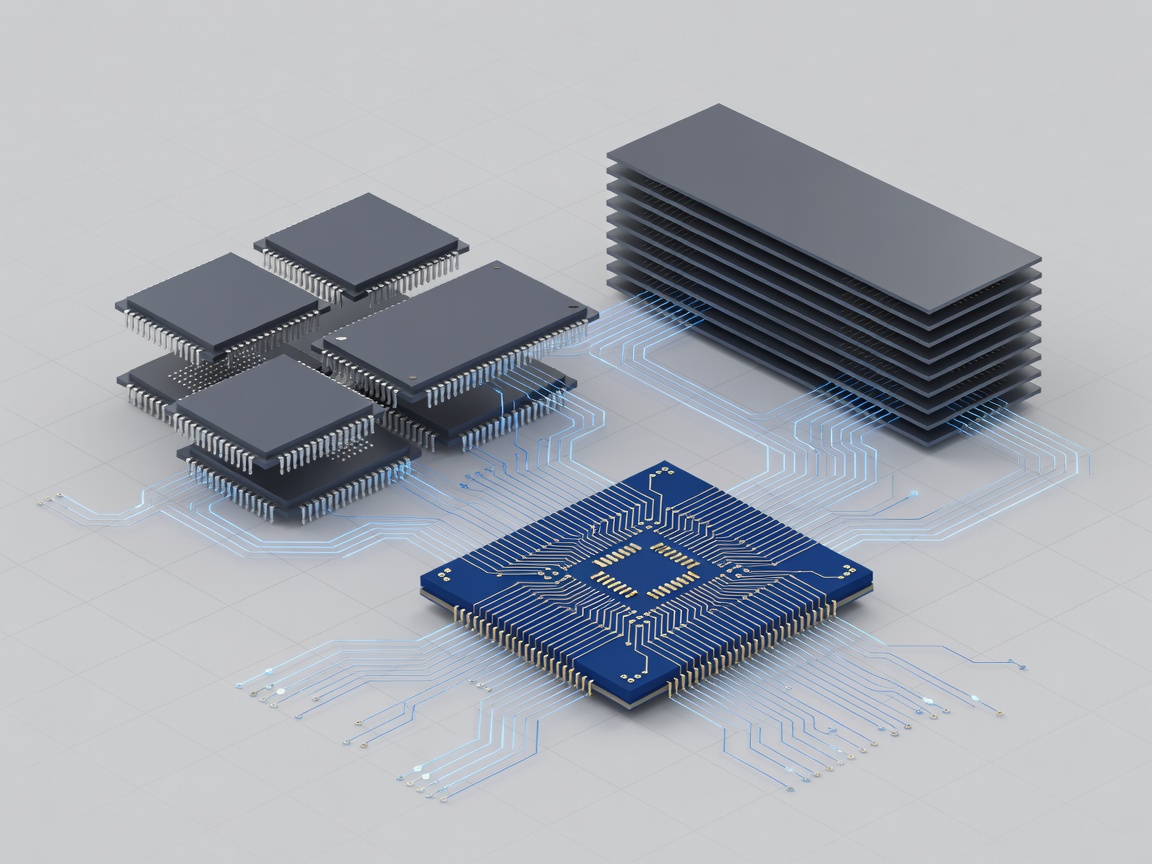
Semiconductor fabrication creates the transistors and interconnects that make modern processors possible. Process technology is only one part of the story: chip architecture, memory bandwidth, packaging, thermal design and manufacturing capacity all influence what a system can deliver. Advanced packaging can place dies and memory closer together, while design teams increasingly combine general-purpose cores with specialised blocks.
GPUs excel at parallel workloads with many similar operations, which is why they are widely used in graphics, scientific computing and machine-learning workloads. A specialised accelerator may improve efficiency for a narrower operation, but it can be less flexible and may require a particular software stack. CPUs remain useful for diverse control-heavy tasks, operating systems and workloads that do not map neatly to parallel execution.
Edge and cloud solve different constraints
Edge computing places processing close to where data is generated: in a device, gateway, factory or local server. This can reduce network round trips, preserve operation during connectivity interruptions and limit how much raw data leaves a site. The trade-offs include tighter power and thermal budgets, more complicated fleet management and a need to maintain software across many distributed machines.
Cloud computing pools infrastructure in data centres and makes large-scale resources available through networks and managed platforms. It can simplify access to substantial compute and storage, but depends on connectivity, service design and operational governance. Latency, data residency, ongoing resource use and vendor dependencies need to be considered alongside raw capability. Hybrid designs are common: an edge system filters or responds locally, while cloud resources support aggregation, training or heavier analysis.
High-performance and quantum systems
High-performance computing (HPC) combines processors, accelerators, storage and high-speed interconnects for demanding scientific, engineering and modelling workloads. Performance depends on how well software parallelises and how data moves between components. More processors do not guarantee proportionally faster results; communication overhead, memory access and algorithms can become bottlenecks.
Quantum computing uses quantum states and operations to explore computational approaches that differ from classical bit-based processing. It is an active research area, not a general-purpose replacement for conventional systems. Potentially useful problems must be mapped to suitable algorithms, and practical systems face challenges around noise, control, error correction and the cost of operating specialised hardware. Classical computing remains central to both the surrounding control stack and most everyday workloads.
Where each approach fits
| Approach | Useful when | Key trade-off |
|---|---|---|
| CPU | Control-heavy, varied general computing | May be less efficient for highly parallel operations |
| GPU / accelerator | Parallel operations or specialised kernels | Software fit, memory movement and flexibility |
| Edge | Local response, resilience or data minimisation | Power, deployment and fleet maintenance |
| Cloud / HPC | Elastic capacity or large coordinated workloads | Network, cost governance and operations |
| Quantum research | Investigating specialised quantum algorithms | Hardware maturity and problem suitability |
Selection without benchmark theatre
Start with the workload: its data size, concurrency, precision needs and acceptable response time. Then evaluate memory movement, cooling, energy supply, software portability and operational expertise. A model inference task at a remote site may justify local acceleration even if the device is modest; batch processing may be better suited to shared cloud resources. There is no universal ranking that settles these choices.
For a useful decision, compare complete systems rather than isolated chip claims, and account for the cost of development, deployment and support. See how software architecture determines portability, or explore the compact hardware constraints behind next-generation devices.